At NVIDIA GTC 2026, Jensen Huang shared a powerful message: Artificial Intelligence is entering a new industrial era.
The data centers that once powered websites, apps, and databases are rapidly transforming into AI factories — massive computing systems designed to generate intelligence at scale.
And the output of these factories is something called tokens — the small pieces of information AI models generate when they write text, create images, answer questions, or reason through problems.
From chatbots and coding assistants to robotics and digital agents, the demand for these tokens is exploding.
AI Is Growing Faster Than Anyone Expected
Just a few years ago, AI was mainly used for:
- recommendations
- image recognition
- search
Today, tools like ChatGPT have changed how people interact with computers.
AI can now:
- write documents
- generate software code
- translate languages
- analyze medical reports
- assist in research
- automate business workflows
But this capability comes with a huge requirement: massive computing power.
Every AI response requires thousands or even millions of tokens to be generated. Multiply that by millions of users, and you can understand why global demand for AI infrastructure is skyrocketing.
The Big Announcements from NVIDIA
GTC 2026 introduced several technologies that will power the next generation of AI systems.
Vera Rubin AI Supercomputer
One of the biggest announcements was the Vera Rubin architecture, NVIDIA’s next-generation AI computing platform.
Named after the famous astronomer who helped discover dark matter, this system is designed to dramatically increase the speed and efficiency of AI workloads.
It brings:
- enormous computing power
- faster GPU interconnects
- advanced cooling systems
- dramatically faster deployment of AI infrastructure
These systems are designed specifically to run AI factories at global scale.
NeMo Claw: Building Smarter AI Agents
Another important announcement was NeMo Claw, part of NVIDIA’s AI software ecosystem.
NeMo Claw helps developers build AI agents that can reason, plan, and take actions.
Instead of simply answering questions, these agents can:
- analyze documents
- interact with software tools
- automate workflows
- perform multi-step tasks
This is a major step toward autonomous digital workers.
The Rise of AI Factories
A key idea highlighted during the keynote was that data centers are evolving into AI factories.
In traditional computing, infrastructure was optimized to run applications.
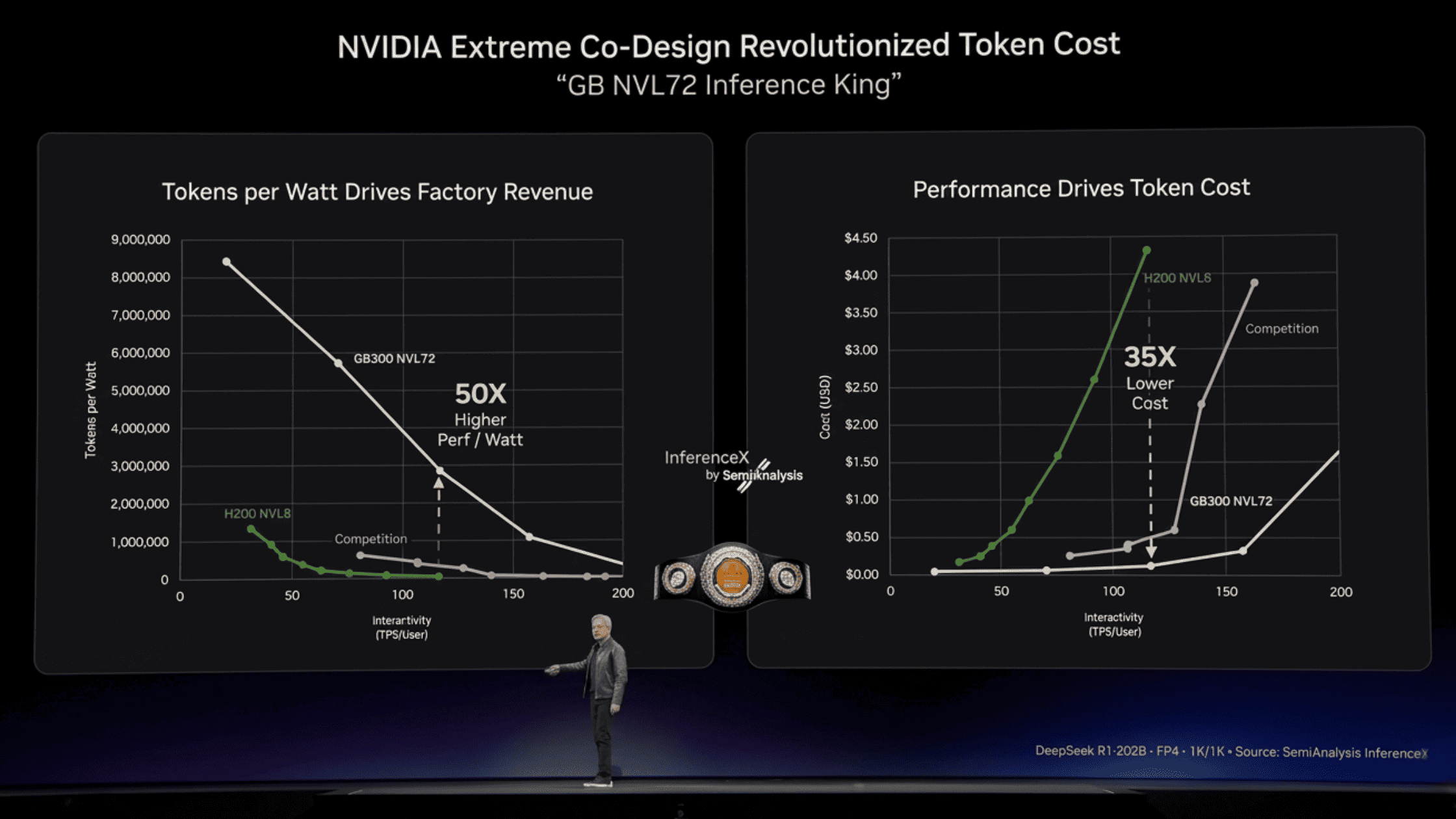
In the AI era, infrastructure is optimized to produce tokens — the building blocks of AI-generated intelligence.
This changes how performance is measured.
Instead of focusing only on raw computing power, companies now focus on how efficiently they can generate tokens.
The ultimate metric becomes:
Tokens per watt — how much AI output you can produce for a given amount of energy.
The Four Things That Matter Most for AI
As organizations deploy AI at scale, four factors become critical:
Cost
AI must be affordable to run at scale. If generating AI responses becomes too expensive, many applications become impossible to operate.
Latency
People expect AI to respond instantly. Whether it's a coding assistant or a customer service bot, fast responses are essential.
Throughput
AI platforms must handle huge numbers of users and requests simultaneously. High throughput ensures systems don’t slow down during heavy usage.
Reliability
Businesses depend on AI services being available at all times. Downtime or instability can disrupt entire workflows.
Why AI Platforms Are Becoming Essential
Running AI systems at scale is far more complex than running traditional software.
It requires careful coordination across:
- powerful GPUs
- model serving systems
- data pipelines
- large-scale infrastructure
This is where specialized AI platforms come in.
Platforms like TIR AI/ML, developed by E2E Cloud, help enterprises deploy and manage AI systems efficiently.
The goal is to help organizations deliver the best combination of:
- Cost
- Latency
- Throughput
- Reliability
while maximizing tokens per watt.
AI Is Becoming a New Industrial Revolution
The announcements at GTC made one thing very clear:
AI is no longer just a technology trend.
It is becoming a global infrastructure layer, much like electricity, the internet, or cloud computing before it.
In the coming years, AI will power:
- digital assistants
- autonomous machines
- intelligent enterprises
- new forms of software
And behind all of these systems will be massive AI factories producing intelligence at scale.
The Road Ahead
We are still at the early stages of the AI revolution.
But the direction is clear.
AI models are getting smarter.
Infrastructure is getting faster.
And platforms like TIR are helping organizations turn this technology into real-world applications.
The race is now on to build the most efficient AI factories — capable of generating intelligence faster, cheaper, and more reliably than ever before.