One API
A single API for the models in the Blaze catalogue — text, voice, OCR, multi-modal and diffusion — reached through an OpenAI-compatible endpoint.
Blaze provides API access to open-weight models. Your application sends a request and receives a model response — there is no GPU capacity to source and no serving stack to build.
Blaze is a model inference API from E2E Networks. It provides a single API for the open-weight models in the Blaze catalogue — text, voice, OCR, multi-modal and diffusion. An application sends a request and receives a model response. Capacity, availability, serving, optimisation and endpoint operations are provided by the platform. Blaze runs on E2E Networks infrastructure located in Indian data centres and is billed in INR.
Two ways to run inference
The same workload can be served by infrastructure you run or by an API you call. These are the pieces of work that move.
| Concern | Running inference yourself | Running inference through Blaze |
|---|---|---|
| GPU capacity | Source, qualify and provision GPU capacity | Send a request to the API and receive a response |
| Contracts & utilisation | Reserve or lease capacity, and manage contracts and utilisation | Capacity and availability are operated by the platform |
| Serving stack | Build the serving stack — serving, batching, quantisation, kernels, scaling | Serving and optimisation are provided in the platform |
| Tuning | Tune latency, throughput and cost on an ongoing basis | Models can be switched without changing your own infrastructure |
| Endpoint operations | Operate autoscaling, failure handling, upgrades and capacity planning | Endpoint operations are handled by the platform |
| Analytics | Build your own token-level analytics and monitoring | Token-level usage, performance and cost analytics are provided |
What Blaze provides
A single API for the models in the Blaze catalogue — text, voice, OCR, multi-modal and diffusion — reached through an OpenAI-compatible endpoint.
Requests are placed across model endpoints by the platform’s routing layer rather than being pinned to a static endpoint per model.
Session persistence, hierarchical context memory and long-context handling are provided in the runtime, so an agent framework does not have to implement them itself.
Token-level usage, performance and cost data are available through the platform, rather than something you instrument and store yourself.
Blaze runs on E2E Networks infrastructure located in Indian data centres and is billed in INR.
Model configurations are benchmarked and tuned across the GPU architectures in the fleet, with KV offload and context transfer across variants in the same model family.
The catalogue
The catalogue covers text, voice, OCR, multi-modal and diffusion models — among them Gemma 4B, Qwen 3.5-9B, Qwen3.8 Flash and Qwen3.8 Max, DeepSeek V4 Flash, Kimi K3 from Moonshot AI, GLM 5.3, IBM Granite 4.2 8B and Tencent’s Hy-MT2 translation models, alongside the sovereign Indic models Sarvam 30B and Sarvam 100B.
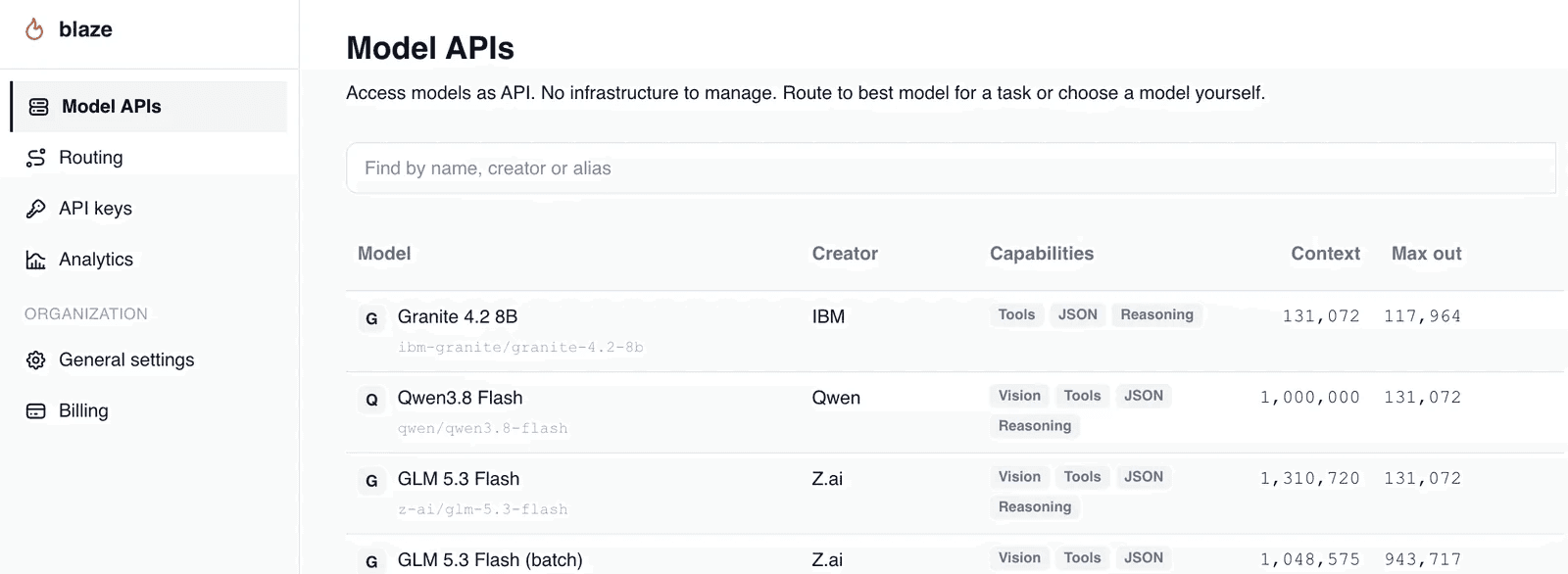
| Model | Creator | Capabilities | Context | Max output |
|---|---|---|---|---|
Granite 4.2 8Bibm-granite/granite-4.2-8b | IBM | ToolsJSONReasoning | 131,072 | 117,964 |
Qwen3.8 Flashqwen/qwen3.8-flash | Qwen | VisionToolsJSONReasoning | 1,000,000 | 131,072 |
GLM 5.3 Flashz-ai/glm-5.3-flash | Z.ai | VisionToolsJSONReasoning | 1,310,720 | 131,072 |
GLM 5.3 Flash (batch)z-ai/glm-5.3-flash:batch | Z.ai | VisionToolsJSONReasoning | 1,048,575 | 943,717 |
DeepSeek V4 Flash Vision Expdeepseek/deepseek-v4-flash-vision-exp | DeepSeek | VisionToolsReasoning | 1,048,576 | 384,000 |
Hy-MT2-1.8Btencent/hy-mt2-1.8b | Tencent | Text only | 8,192 | 4,096 |
The full catalogue, with the current list of models and their capabilities, is in the Model APIs section of the Blaze console.
Model routing
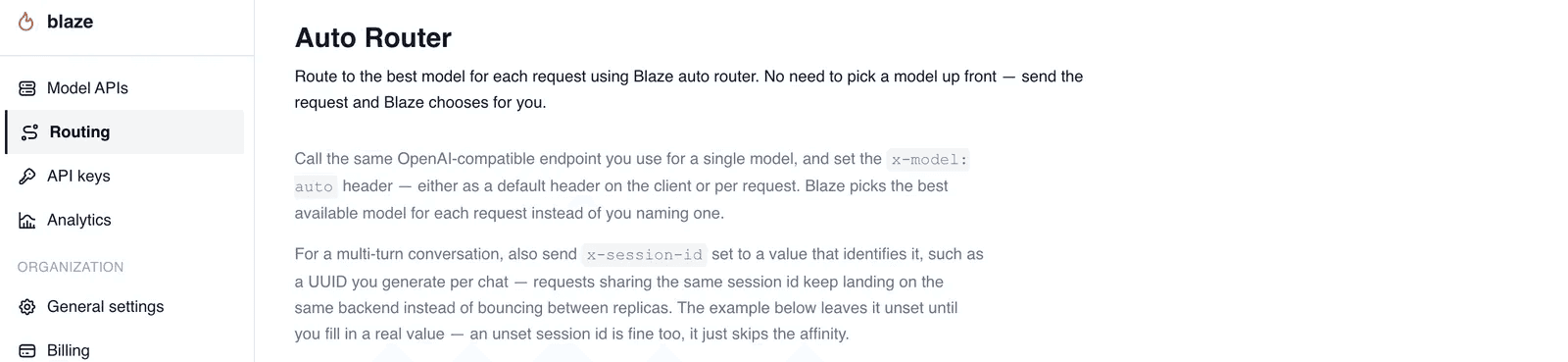
Call the same OpenAI-compatible endpoint you would use for a single model, and set the x-model: auto header — either as a default header on the client or per request. The routing layer then places each request across model endpoints instead of you naming one up front.
from openai import OpenAI

client = OpenAI(
    api_key="BLAZE_API_KEY",
    base_url="https://blaze.e2enetworks.net/v1",
    default_headers={
        "x-model": "auto",
    },
)

response = client.chat.completions.create(
    model="auto",
    messages=[{"role": "user", "content": "Extract the payment terms from this clause."}],
)
print(response.choices[0].message.content)
import OpenAI from "openai";
const client = new OpenAI({
apiKey: process.env.BLAZE_API_KEY,
baseURL: "https://blaze.e2enetworks.net/v1",
defaultHeaders: {
"x-model": "auto",
},
});
const response = await client.chat.completions.create({
model: "auto",
messages: [{ role: "user", content: "Extract the payment terms from this clause." }],
});
console.log(response.choices[0].message.content);curl https://blaze.e2enetworks.net/v1/chat/completions \
-H "Authorization: Bearer $BLAZE_API_KEY" \
-H "Content-Type: application/json" \
-H "x-model: auto" \
-d '{
"model": "auto",
"messages": [
{ "role": "user", "content": "Extract the payment terms from this clause." }
]
}'x-model: autohttps://blaze.e2enetworks.net/v1 — the OpenAI-compatible path, so existing clients need a base URL and a key, not a rewrite.Under the hood
Experience the bleeding-edge inference research. Blaze is a custom inference stack with optimised kernels, the latest decoding techniques and advanced caching baked in.
What Blaze is, which models it serves, and how requests are routed.
Blaze is a model inference API from E2E Networks. It provides a single API for the open-weight models in the Blaze catalogue, covering text, voice, OCR, multi-modal and diffusion models. An application sends a request and receives a model response. Capacity, serving and endpoint operations are provided by the platform.
The Blaze catalogue covers text, voice, OCR, multi-modal and diffusion models, including Gemma 4B, Qwen 3.5-9B, Qwen3.8 Flash and Qwen3.8 Max, DeepSeek V4 Flash, Kimi K3 from Moonshot AI, GLM 5.3, IBM Granite 4.2 8B, Tencent Hy-MT2 translation models, and the sovereign Indic models Sarvam 30B and Sarvam 100B. The current list is shown in the Model APIs section of the Blaze console.
Yes. Blaze exposes an OpenAI-compatible endpoint, so an existing OpenAI client can be pointed at the Blaze base URL. In Python, this means setting base_url on the OpenAI client and supplying a Blaze API key; the rest of the chat completions call is unchanged.
Requests are placed across model endpoints by the Blaze routing layer rather than being pinned to a static endpoint per model. A caller can name a model, or send the header x-model: auto and have the platform select a model for each request. Models can be switched without changes to the caller’s own infrastructure.
Session persistence, hierarchical context memory and long-context handling are provided in the Blaze runtime, so an agent framework does not have to implement them itself. Several models in the catalogue also expose tool calling, JSON output and reasoning, and context windows above one million tokens.
Blaze runs on E2E Networks infrastructure located in Indian data centres and is billed in INR.
Running inference yourself means sourcing and provisioning GPU capacity, managing capacity contracts and utilisation, building a serving stack covering batching, quantisation, kernels and scaling, tuning latency, throughput and cost, and operating autoscaling, failure handling and upgrades. On Blaze these are operated by the platform and reached through the API.
Token-level usage, performance and cost data are available through the platform in the Analytics section of the Blaze console, rather than being something the caller instruments and stores itself.
Blaze uses a custom inference stack. Model configurations are benchmarked and tuned across the GPU architectures in the fleet, requests are placed by the platform’s orchestration layer, and KV offload and context transfer are supported across variants within the same model family, including FP8 and BF16.
Tell us about the workload and we will set you up with access to the Blaze API and the console.